

The psychology behind how leadership expectations can elevate - or limit - employee potential.
Let’s look into some organizational psychology research that proves just how much INFLUENCE leaders actually have on the success, and failure, of their team members’ performance.
If you haven’t heard of the Pygmalion Effect, read on as it’s critical knowledge for anyone leading a team.
If you have heard of it, and brushed it off, it’s likely because you haven’t heard of the Golem Effect that wickedly supports what Rosenthal and Jacobson discovered back in ’68.

The Pygmalion Effect:
High expectations placed on individuals by their superiors leads to an increase in their performance.
The Golem Effect:
The psychological phenomenon that when superiors hold LOW expectations of an individual, it leads to worse performance.

Here's why this research matters to you:
In a landmark organizational study led by Dr. Dov Eden, managers were told that a few of their employees had “unusually high potential” based on their aptitude test. In reality, their scores were actually average.
The results were wild: The employees whose managers BELIEVED they were superstars started to outperform the others.
Eden’s research repeatedly demonstrates that objective evaluation from leaders is very difficult to obtain and that leaders tend to subconsciously communicate their high or low expectations through micro-behaviors towards each individual team member.
These micro-behaviors present themselves as:
- Quality in feedback and support
- Opportunity allocation
- Social connection
Leaders are likely to give more supportive, detailed, and specific feedback to team members that they feel have more potential.
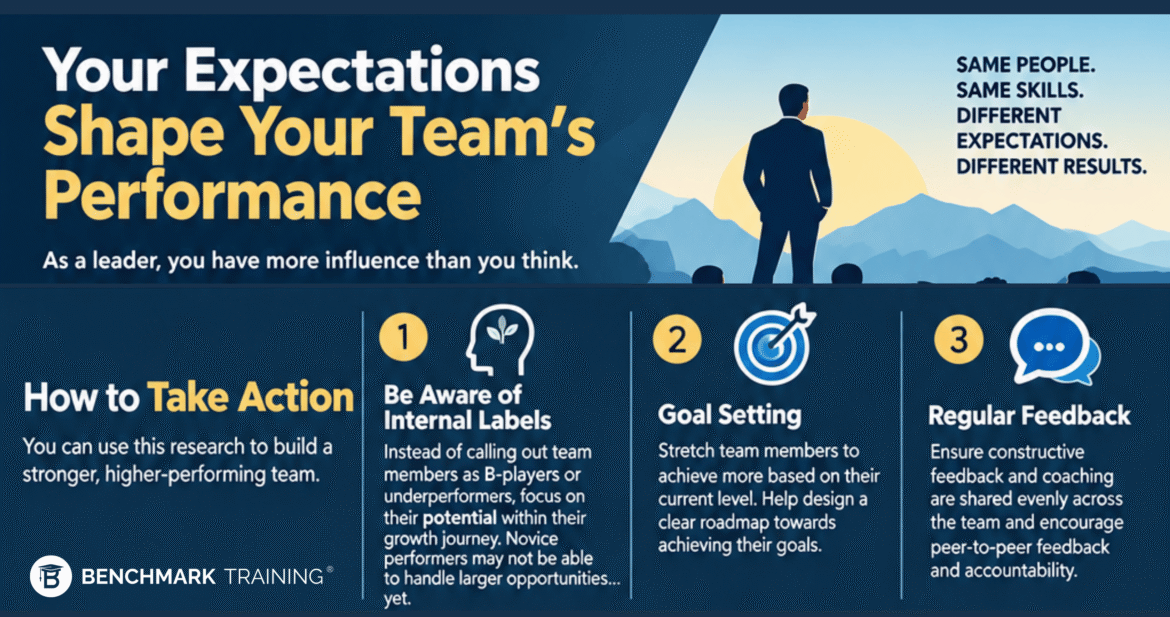
Here’s how to take action on this information:
- Be aware of internal labels:
Instead of calling out team members as B-players, or underperformers, focus more on their potential within their growth journey. Novice performers may not be able to handle larger opportunities… yet. - Goal Setting:
Stretch team members to achieve more based on their current level. Help design a clear roadmap towards achieving their goals. - Regular Feedback:
Ensure constructive feedback and coaching are shared evenly across the team and encourage peer-to-peer feedback and accountability.
- Be aware of internal labels:
These research findings are not a reason to keep poor performers on your team, or to think that you can solely coach your way to a high performing team.
What you can takeaway is that your bias will impact the performance of your team members in either direction…
Either maximizing their POTENTIAL… or squashing it.
Looking to maximize your team’s potential? Contact Benchmark Training to meet with an Executive Coach.