

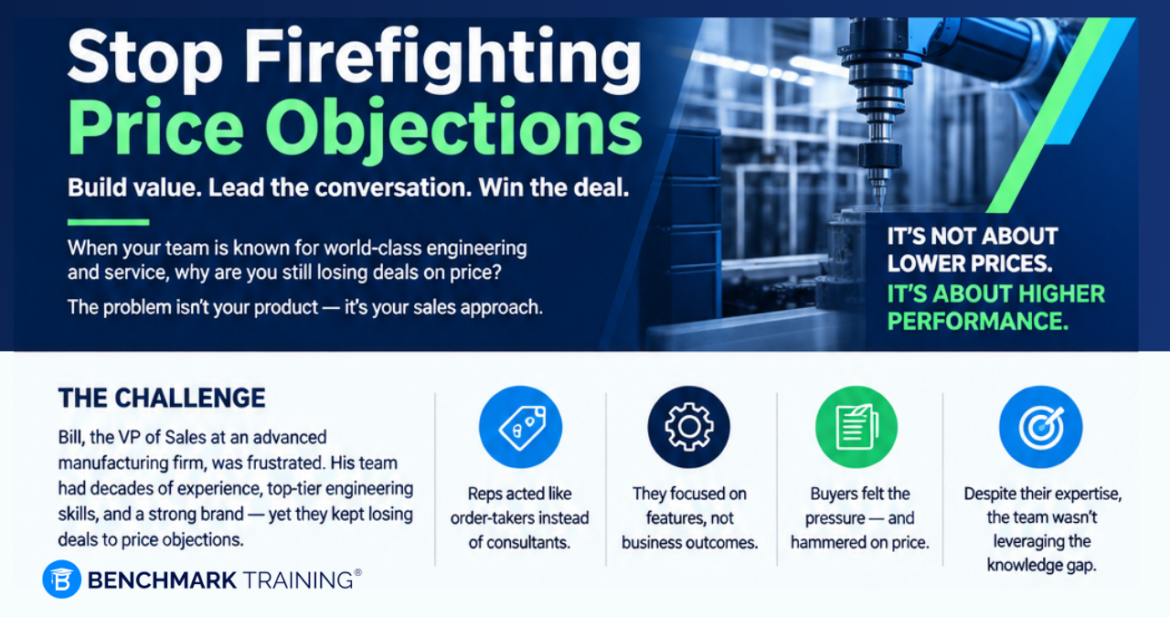
How a 5 step playbook rewired an engineer minded sales team to sell with value, overcome objections, and win-high margin deals
Bill just finished his 5 a.m. workout and he already had a text from one of his sales reps asking for some additional leverage on the price of his largest deal.
“GM! [The client] is just about ready to pull the trigger, but their procurement manager says they’re 12% over budget for this project. Can I give them just 8% more of our final price?”
Bill shook his head in disbelief. There was no way $40k was going to kill a half-million-dollar deal that will save our buyer hundreds of thousands a year in waste, delivery delay fines, and labor costs.
It just didn’t make sense.
Bill is the VP of Sales for an advanced manufacturing firm that builds high-precision, highly engineered capital equipment. We’re talking bulletproof brand quality, world-class engineering, and unmatched service.
Yet, he’s watching his team act like they’re selling a commodity.
To make matters worse, Bill can still hear the echoes from the last board meeting where the board handed a firm ultimatum:
“Raw material costs are up, labor costs are up, and margins are shrinking… We need the team to raise margins by 7% this year, or we need to rebuild the entire team.”
Bill knows his team is not lazy and he knows they’re brilliant. In fact, most of his reps were engineers at some point in their career. They know CAD, tolerances, and specs better than their buyers in many cases.
It was the technical feature-dumping and discounting that got them every time.
That’s how I met Bill. A former colleague of his worked with Benchmark Training on a similar project and introduced us to see if Bill’s team could benefit from learning the soft skills and sales techniques that helped his team a few years ago.
The Diagnosis: When Expertise Becomes the Blindspot
When Bill and I sat down together, he walked me through the story you just read and more. It was clear that Bill’s team wasn’t losing deals because the prices were too high. They were losing deals because his team was acting like high-tech order takers instead of business consultants.
His reps had been in Advanced Manufacturing for decades and had sold dozens of highly engineered capital equipment to all the big names. In contrast, their buyers would purchase a product like this maybe once or twice in their career, if ever.
The team wasn’t leveraging that knowledge gap to guide and advise the buyer, instead, they were simply getting spec sheets and emailing high-dollar proposals over. Their buyers were highly educated engineers, but they hadn’t been through this type of process before. So they did what we all do in these situations. They hammered us on price.
To help rewire this transactional sales approach as quickly as possible, and with as much buy-in from the frontlines as possible, we implemented a 5 step playbook that’s designed specifically for advanced manufacturing and complex sales cycles.
Step 1: Switch from Order-Taking to a Consultative Buying Experience
The first breakthrough happened when we pointed out the massive experience asymmetry between the sales team and their buyers. When a buyer purchases capital equipment on rare occasions, the process is terrifying for them. They are worried about making a career-ending mistake.
When Bill’s reps acted like drive-thru order-takers—simply asking, “Do you want fries with that?”, they forced the buyer to lead a process they weren’t qualified to lead.
We retrained the team to step up as trusted, authoritative guides. Because the reps had seen over a hundred successful installations throughout their careers, they knew where the hidden landmines were, what operational bottlenecks would pop up, and what long-term risks the buyer hadn’t considered.
Instead of waiting for a spec list, sellers began educating buyers on how to buy. They shifted the dynamic from a vendor submitting a bid to a consultant co-designing a high-ROI business solution.
Step 2: Ask Strategic Questions Early (Focus on Business Needs, Not Features)
In advanced manufacturing, sellers love to talk about features: spindle speeds, cycle times, robotic arm repeatability, and custom alloy finishes.
The problem? C-suite buyers don’t buy cycle times; they buy business outcomes. We forced the sales team to abandon early-stage “feature dumping” and replace it with strategic discovery questions focused squarely on mission-critical business priorities.
Instead of asking: “What tolerances do you need on this production line?” We taught sellers to ask: “How is your current production constraint impacting your ability to hit your Q3 revenue targets?” “If scrap rates on this line stay at 4%, what does that do to your gross margin projections for the year?” “What is executive leadership pressing you to fix on the factory floor before the end of the fiscal year?”
By uncovering the high-level business goals behind the purchase, the sellers stopped competing on machine specs and started competing on business problem-solving.
Step 3: Gain Detail-Level Clarity on the "Cost of the Problem"
Price objections happen when the buyer perceives the price tag to be larger than the problem itself. To eliminate price friction, we introduced Bill’s team to a simple sales formula:
Buy = Cost of the Problem > Cost of the Solution
If a buyer thinks your solution costs $500,000, but they view their problem as a $200,000 inconvenience, they will demand a discount every single time. But if you help them realize that their unaddressed problem is costing them $250k a year, a $500,000 solution feels like a bargain.
Our Benchmark coaches worked with the reps to build detailed financial modeling frameworks during discovery.
Sellers learned to guide buyers through a granular breakdown of:
The Implications of Inaction: Scrap rates, unexpected downtime, labor overtime, missed delivery penalties, and customer churn.
The Financial Payoff: Expanded capacity, reduced labor overhead, lower warranty costs, and faster time-to-market.
When buyers saw their own operational waste mapped out in black and white, the company’s price tags no longer looked expensive—they looked essential.
Step 4: Build a Reverse-Engineered Purchasing Timeline
Even when a buyer agreed that the product was valuable, deals were stalling out. Buyers would say, “This looks great, but we’ll look at budgeting this for next year.”
To create genuine, buyer-driven urgency without using sleazy tactics, the sellers had to answer one critical question: Why fix this problem now, rather than later?
Once the seller and buyer calculated the daily/monthly Cost of the Problem, delaying the purchase by six months meant burning hundreds of thousands of dollars in wasted operational costs.
From there, sellers stopped asking “When do you want to place the order?” and started asking “When do you need this system fully operational and producing revenue on your factory floor?”
If the buyer needed the new line running by October 1st, the seller worked backward in real-time with the buyer:
🔹 System fully operational. (Install goal date)
🔹 On-site installation and team training (2 weeks).
🔹 Shipping and factory acceptance testing (6 weeks).
🔹 Custom manufacturing and assembly (12 weeks).
🔹 Final engineering design and CAD sign-off (2 weeks).
🔹 Procurement authorization and legal review (4 weeks).
Suddenly, the buyer realized: “If we want this running by early Q4, we have to sign the authorization by January.” The urgency came from the buyer’s own operational deadlines, eliminating late-stage delays.
Step 5: Map and Engage the Full Buying Process
The final piece of the puzzle was eliminating late-stage surprises. How many times has a sales rep worked with a great contact for three months, only for a CFO they never spoke to veto the deal at the finish line?
We taught Bill’s team to identify and multi-thread across all three key buying personas early in the discovery phase:
- The Champion (e.g., Plant Manager / Engineering Lead): The person who feels the day-to-day pain and wants the physical solution.
- The End Users (e.g., Line Operators & Maintenance Techs): The people who will actually operate and maintain the equipment. If they fear the tech or find it too complex, they will quietly sabotage the deal.
- The Authorizer (e.g., CFO / VP of Finance / Executive Committee): The person who holds the checkbook and cares exclusively about financial return, risk mitigation, and timeline to ROI.
Bill’s team learned never to advance a proposal until they engaged all three personas. They brought End Users into design reviews early, helped Champions build internal business cases, and presented clear financial payback models directly to Authorizers.
By aligning all stakeholders upfront, late-stage procurement ambushes all but disappeared.
The Diagnosis: When Expertise Becomes the Blindspot
Let’s be real here; behavior change is never an overnight switch. The first few weeks were awkward for the sales team.
We were drilling social psychology concepts that were just foreign to them. We were leveraging soft-skills to help make the financial questions smoother.
Reps stumbled over cost-quantification formulas. They felt more like CFOs than engineers. The weekly support kept them going and they invested time into the online training content, the weekly group discussions, and most importantly, the client conversations.
The reps were fully surprised that their buyers were okay talking about financial returns and building a business case. In fact, for the most part, those conversations were welcomed.
What pushed the team over the edge was seeing deals move towards the finish line faster and seeing million dollar deals marked Closed-won in their CRM.
Over the next two quarters, the results were astonishing:
🔹 Discounts requests dropped
🔹 Gross Margins increased beyond the leadership teams’ minimums
🔹 Sales moved faster
Bill and his team stopped firefighting and became trusted advisors.
Interested in learning how sales coaching and training will help your team? Contact Benchmark Training to meet with an Executive Coach.